
the internet has eyes
About this work
Something we talk quite a bit about in my program at university is the notion that technology is not neutral. That is to say, because humans are involved in its creation, technology can’t be unbiased. For example, for a very long time, AI image generators really leaned into racist stereotype. This is no fault of the AI itself, but rather the fault of the programmers and the people who made the training data.
Recently in a lecture, my professor discussed the way that technology discreetly depends on people in another way: outsourcing, specifically data workers. We talked about people in Kenya whose job is to sit and look at gruesome, pornographic, and other kinds of troubling content so that you and I as privileged Westerners don’t have to. And these people are often people who, because of their personal or regional economic situation need to work and will do anything for anything.
But imagine the mental toll! Every day, for hours, you have to label horrifying content to keep it out of social media feeds and AI training to make sure your key turns in the door next month. Meanwhile, in the West, we are privileged enough to go about our days — doing assignments, asking AI whatever we ask it, scrolling mindlessly — and never see this content. But if we ever do, we curse the algorithm.
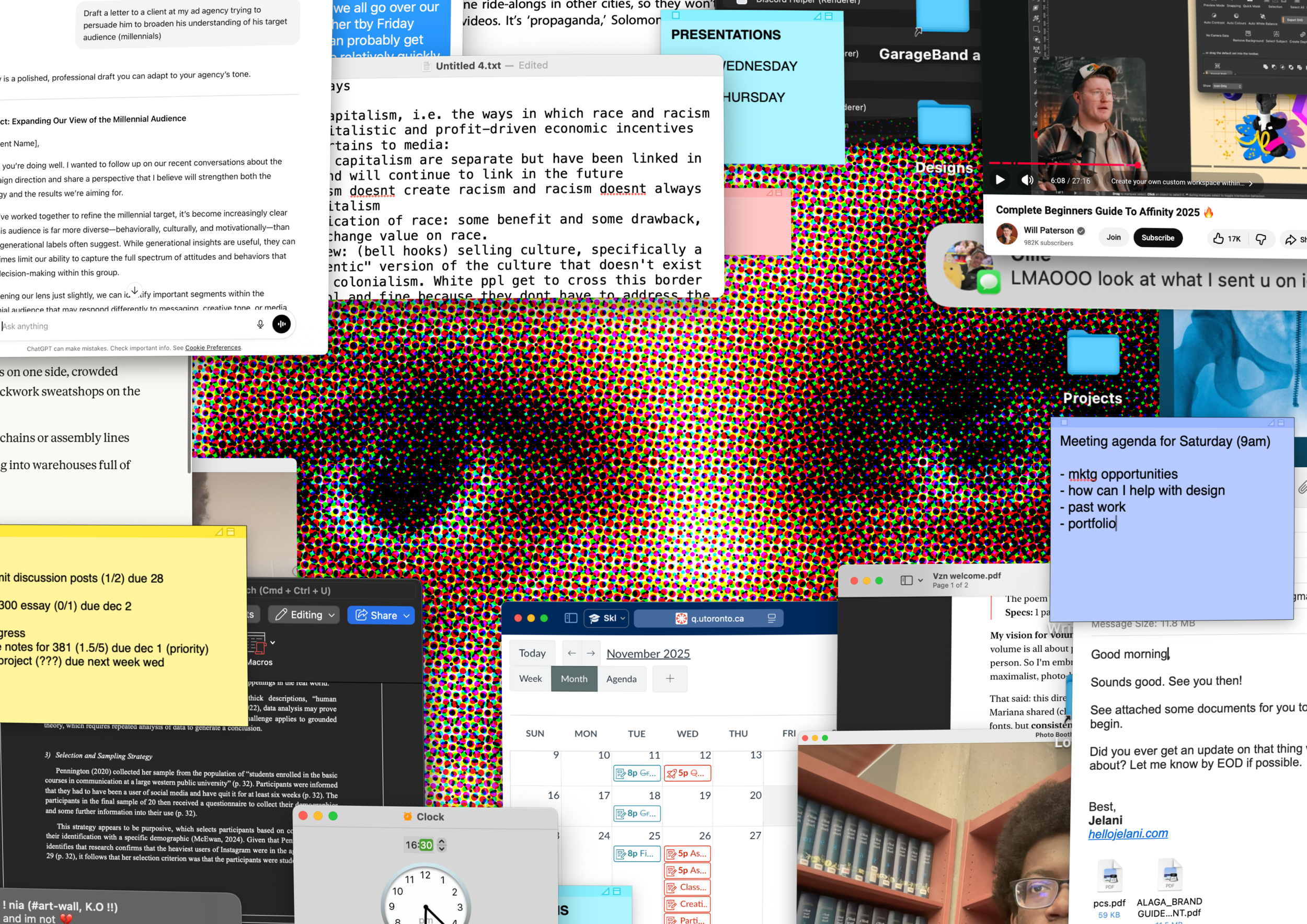
This isn’t meant to criticise or demonise anyone for their use of social media or AI. We all benefit from this exploitation, and we exist at such a time where total unplugging and refusal is more difficult by the day. So my appeal is that we all think: Who’s doing the looking on the other side of the internet?
Process
I had an idea for this piece where the viewer was “in the phone” or “in the laptop” and took a bunch of photos on my laptop webcam to then use. The idea would be to overlay UI elements and apps on top on in reverse; this then makes you the person doing the looking on the other side of the internet. But I scrapped the idea because I felt insecure and uncomfortable with my face being the focal point of the piece.
The new Affinity app had been sitting and collecting dust in my dock. But then just decided to played around with it a bit to get comfortable. When I had the idea for the current version of this artwork, I decided to use Affinity for it.
I found a ton of images of eyes on Pinterest and overlaid them atop one another at differing opacities with the blend mode Overlay. Then I added a halftone to the entire thing. Then, I took screenshots: different tabs on my laptop. AI agents like ChatGPT and Claude, YouTube, MS Word, a real reading for one of my classes, sticky notes, iMessage, Mail, etc. Some of these are real documents of mine or referencing real things I have to do; some were manufactured for the image. I placed them sporadically over the image of the eyes and then added a lens distortion effect.
Type
Art
Tools
Affinity
Client
Personal
Year 2025